Academic strategy analysis
Valve and Steam
Advantage also lies
in relationships.
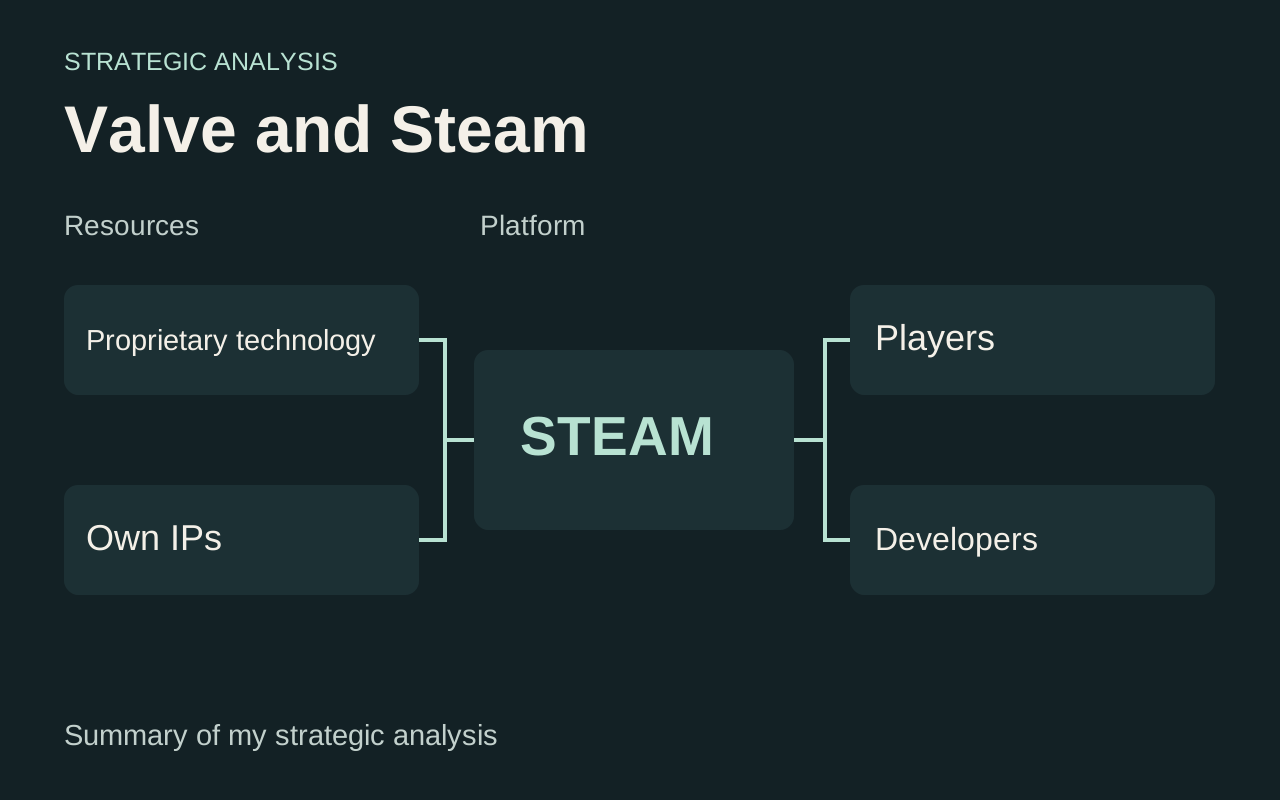
My analysis connects technology, developers and players to propose priorities for the Steam ecosystem.
- My role
- Industry and resource analysis, and recommendations
- What it shows
- Ecosystems · Competitive strategy · Priorities
- Project type
- Academic strategy analysis
The decision I would propose
I would prioritise conditions for developers, the community and project coordination.
Academic analysis: the proposals were not implemented and do not establish outcomes for Valve.Project details and scope
Prioritise resources and relationships in a competitively pressured ecosystem.
02 / My contributionI wrote the industry, resource and stakeholder analysis and the recommendations.
03 / Evidence68-page document using Porter, PESTEL, VRIO and CAME.
04 / ConclusionI identified proprietary technology and ecosystem relationships as foundations of its advantage.
Academic research: I distinguish observed results from proposed actions.
Question and synthesis
An analysis of resources, ecosystem and competitive environment to identify challenges and propose strategic recommendations.
SYNTHESIS OF MY ANALYSIS
Valve’s strength depends not only on its products, but also on the capabilities and relationships that shape its ecosystem.
Discover how I reached this conclusionMy contribution and context
I wrote the academic strategic analysis of Valve. The case connects external and internal diagnosis to proposals using Porter, PESTEL, VRIO, stakeholders, SWOT and CAME.
A 68-page strategic case study combining external and internal diagnosis, competitive frameworks and strategy and measurement proposals.
What does Valve have?
Before choosing an action, I distinguished capabilities that offer differentiation from those enabling market participation.
01 / Assessment in the paper
Proprietary technology
Source Engine and Steamworks are classified as a sustained advantage in the VRIO analysis.
What it implies
Steamworks represents platform tools for studios; its relationship with distribution connects capabilities and developers.
Evidence · p. 21 ↗02 / Assessment in the paper
Intellectual property
The catalogue of owned IP is classified as a sustained advantage.
What it implies
I connect it to the player offering, without claiming that an IP causes loyalty.
Evidence · p. 21 ↗03 / Assessment in the paper
Distribution infrastructure
Distribution infrastructure is classified as competitive parity, not a sustained advantage.
Which challenges does it face?
Resources do not explain strategy in isolation. I connected them to participant needs and three tensions in the diagnosis.
- 01 / Developers
Why does the relationship between Valve and studios matter so much?
Porter assesses rivalry as high; the proposals address competition for the catalogue.
See the reasoning
Competition for the catalogue makes developer relationships relevant.
View evidence · pp. 8, 26, 29 ↗ - 02 / Players
What keeps players interested in an ecosystem?
Loyalty in the face of alternatives is a proposal objective, not a measured effect.
See the reasoning
Those interests inform the interpretation of appeal relative to alternatives.
View evidence · pp. 26, 30 ↗ - 03 / Employees and teams
How can creative autonomy coexist with effective coordination?
The challenge is to improve planning without losing creative autonomy.
See the reasoning
Their interest in autonomy should be considered alongside the need for coordination.
View evidence · pp. 27–28 ↗
What would I recommend?
Proposal, not implemented. My strategic interpretation.
Improve incentives and conditions for developers.
High rivalry from other platforms and competition for the catalogue.
Why I connect these elements
I interpret that nurturing studio relationships may be a priority when competing with other platforms.
Source: pp. pp. 26, 29 ↗Strengthen social features, personalisation and community.
Consolidate ecosystem loyalty against alternatives.
Why I connect these elements
I connect player interests with maintaining a differentiated offering.
Source: pp. pp. 26, 30 ↗Improve release planning and project coordination without losing creative autonomy.
Address the delays and infrequent releases identified in the diagnosis.
Why I connect these elements
This tension informs a balanced proposal, rather than a choice between two extremes.
Source: pp. pp. 27, 28 ↗Explore localised pricing, promotions and regional support.
An opportunity for expansion into emerging markets proposed in the study.
Why I connect these elements
This reading connects the environment with localised pricing and regional support.
Source: pp. pp. 25, 31 ↗Explore the academic analysis
Frameworks and evidence from the paper
Competitive pressure
The study rates rivalry and customer power as high, supplier power as moderate, substitutes as moderate, and new entrants as moderate–high.
Sources: pp. 8–12.
Environment and opportunities
It considers digital regulation and privacy, price sensitivity and emerging markets, technological change and hardware sustainability.
Sources: pp. 12–15.
Resources and capabilities
The case rates proprietary technology and IP as sustained advantages, diversified revenues as a temporary advantage and distribution infrastructure at parity.
Sources: pp. 21–22.
Relationships that shape strategy
Players, developers and employees are considered high-influence groups; the study records interests in quality, distribution and creative autonomy.
Sources: pp. 15–16.
High pressure from rivalry and customers
The case diagnosis rates both forces as high.
Source: pp. 8 and 10 ↗Steam dependence and coordination need attention
The study identifies platform dependence, infrequent releases and difficulties in decentralised coordination.
Source: pp. 23 and 28 ↗Resources with different competitive implications
The analysis distinguishes technology and IP, considered sustained advantages, from distribution infrastructure, classified at parity.
Source: pp. 21–22 ↗Full paper and excerpts
A PIECE OF THE WORK
CAME proposals: an excerpt from the Valve study
Why I show the CAME proposals
An analytical framework is useful if it leads to a priority. I linked coordination issues and release frequency to better planning without losing creative autonomy. These are proposals, not results of an intervention at Valve.
68-page document with external and internal analysis, strategic proposals and measurement objectives. Crops show legible original excerpts.
Open the full paperView more excerpts
Scope and learning
Scope of the conclusions
- My diagnosis is qualitative and refers to the study's context; it does not measure the current market or include primary research within Valve.
- The document's SMART goals are proposed targets, not achieved results.
- Porter and VRIO assessments are qualitative. I use them to organise the diagnosis and justify proposals, not as numerical performance measures.
The analysis links identified weaknesses and pressures to concrete decisions: developer conditions, community, coordination and localisation.
Time43.56 %
Information32.52 %
Friends28.83 %