Individual academic research
Emotional marketing and players
The needs already exist;
marketing can amplify them.
My reading of the study: fun, escapism and community help inform what value to communicate. An interpretation of observed motivations, not a demonstrated causal relationship.
- My role
- Study design, interviews, survey and analysis
- What it shows
- Listening to players · Research · Interpretation
- Project type
- Individual academic research
The decision I would propose
I would adapt positioning and messages to the observed motivations, avoiding artificial urgency.
Non-probability sample and self-reported data: associations, not causation or conclusions about all players.Project details and scope
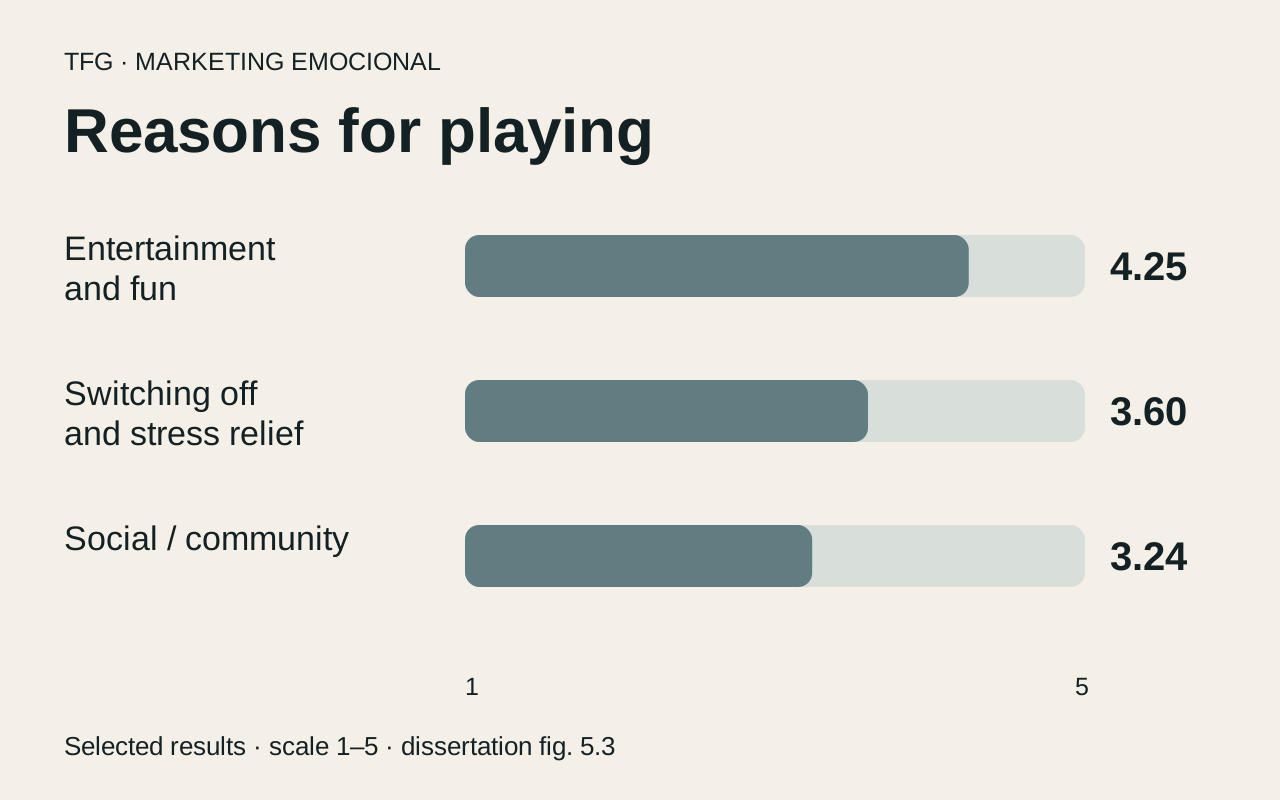
Fun4.25
Unwinding3.60
Community3.24
Academic research: I distinguish observed results from proposed actions.
Understand how emotions, purchasing and wellbeing relate to playing.
02 / My contributionI designed the study, conducted four interviews and analysed 322 responses with SPSS.
03 / EvidenceInterviews and self-reported data from a non-probability sample.
04 / ConclusionI interpret marketing as an amplifier of players’ existing motivations.
Main findings
MY MAIN INTERPRETATION
The needs already exist; marketing can amplify them.
I interpret marketing as an amplifier of existing motivations, such as fun, unwinding and community. This is an interpretation of the study, not a demonstrated causal relationship.
What does this mean for marketing?
EVIDENCE → RECOMMENDATION
Select a finding to see the decision it informs.
WHAT I OBSERVED
Fun and unwinding do not carry equal weight
83% agree with fun and 58% with unwinding: a difference of 25 percentage points in the sample.
WHAT I PROPOSE
Communicate the value of leisure, wellbeing and social relationships with nuance
The perceived balance is positive and coexists with interference with responsibilities. I propose neither exaggerating nor omitting the downside.
Communicate leisure's value with nuance
Interpretive relationship in the case; recommendations are not measured results.
View all findings
Fun and unwinding do not carry equal weight
83% agree with fun and 58% with unwinding: a difference of 25 percentage points in the sample.
Source: pp. 46–47 ↗Nostalgia outweighs promotional stimuli
57% acknowledge nostalgia; its rating exceeds the reported influence of trailers and creators.
Source: p. 47 ↗Critical awareness and unplanned purchases coexist
70% perceive companies using emotions; 58% report unplanned purchases once or several times. These are aggregate percentages: they do not necessarily identify the same people.
Source: pp. 47–48 ↗Context and conclusion
Undergraduate dissertation in Marketing and Market Research at the University of León, focused on the player experience.
Leisure provides value and can also interfere with responsibilities.
Reading motivations and wellbeing together leads me to recommend communication acknowledging both sides of the experience; observed associations do not establish causation.
Source: pp. 47 y 51 ↗- Type
- Academic dissertation · Sole author
- Date
- July 2026 · Academic year 2025/2026
My contribution
I conducted the entire study: designed it, interviewed four players, built the questionnaire and analysed 322 responses with IBM SPSS, then wrote the conclusions and recommendations.
My dissertation was supervised by Dr Ana Lanero Carrizo.
What the results show
Results by playtime
Switch variables; select a bar to view details.
Mean on a 1–5 scale · n = 322 · Hours played per week
ANOVA · F(4, 317) = 23.75 · p < 0.001
The overall test alone does not identify which pairs differ or establish causality.
View Tables 5.3 and 5.5 ↗Perceived wellbeing is higher in groups with more playtime, with an intermediate drop at 15–21 h. This is association in the sample, not a causal effect.
Non-probability sample · Associations do not establish causation.
Why I started with interviews
Before building the questionnaire, I interviewed four players. I wanted to identify experiences and purchasing situations in their own words, rather than asking only about what I considered relevant.
From analysis to decision
- 01
Interviews
Four conversations to explore experiences and motivations.
- 02
Questionnaire
I translated research questions into variables and items.
- 03
Survey
I collected 322 valid responses.
- 04
Statistical analysis
I analysed the data with SPSS.
- 05
Interpretation
I distinguished associations from causal explanations.
- 06
Recommendations
I connected findings to proposed decisions.
Selection and qualitative analysis
Purposive selection of regular players, a semi-structured interview guide and thematic analysis of responses.
Source: pp. 34–37.
Instrument and sampling
Anonymous Google Forms questionnaire with 1–5 scales, using convenience and snowball recruitment in online communities and personal networks.
Source: pp. 37–40.
Reliability, comparison and relationships
Cronbach's alpha for reliability; ANOVA and Student's t-tests to compare groups; Pearson correlations and multiple linear regression to explore relationships.
Source: pp. 39–40 y 49–55.
Recommendations and their rationale
Activate authentic nostalgic connections to the franchise or product
57% acknowledge nostalgia, and interviewees link it to their history with the product.
Source: pp. 47, 56, 59.Avoid monetisation based on artificial urgency or mandatory daily logins
Low aggregate acceptance of FOMO and association with mission pressure. Critical awareness does not eliminate unplanned purchasing.
Source: pp. 48, 49, 58, 59, 60.Pay attention to players with more playtime and frequent purchases
Marketing, consumption and conflict with responsibilities vary with hours played.
Source: pp. 51, 53, 54, 59, 60.Communicate the value of leisure, wellbeing and social relationships with nuance
The perceived balance is positive and coexists with interference with responsibilities. I propose neither exaggerating nor omitting the downside.
Source: pp. 48, 49, 59, 60.
Full paper and excerpts
Full 83-page dissertation, questionnaire, interview guide and analysis tables. Dissertation grade: 10/10.
Open the full paper ↗View more excerpts
Limitations and learning
Scope of the conclusions
- Non-probability sampling and self-reported data: exploratory results, not generalisable to all players.
- Cross-sectional, correlational design: cannot establish causation. The four interviews provide depth, not representativeness.
- The age categories in table 5.1 total 320 cases against the stated 322 valid responses. Because of that discrepancy, I draw no conclusions about age distribution.
Combining interviews and a survey helps interpret responses. It also requires distinguishing association from causation and checking which measures form consistent scales.
A PIECE OF THE WORK
Playing motivations: original dissertation chart
What decision this chart informs
Fun and unwinding carry different weights in the sample. I use that difference to refine the value proposition; I do not assume all players seek the same thing or that association proves causation.